Life on Invisible Camera: What Performing for an Audience Is Doing to Your Mental Health

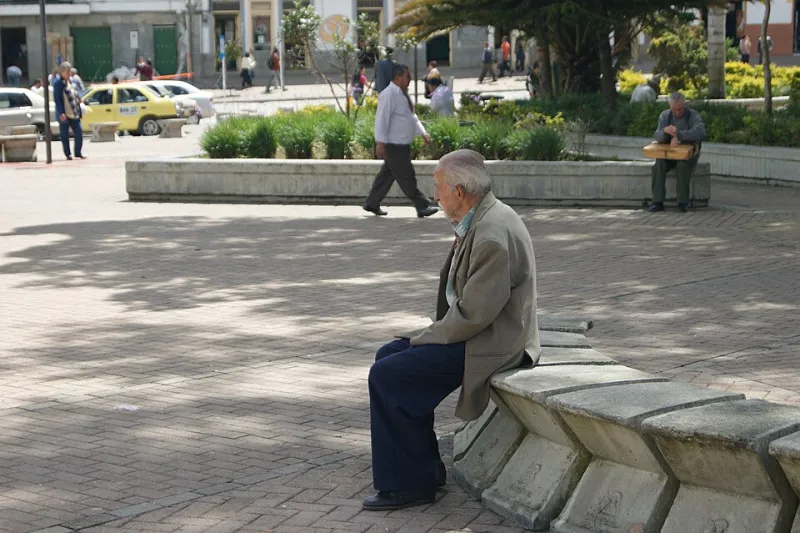
Photo: Photograph by Mike Peel (www.mikepeel.net)., CC BY-SA 4.0, via Wikimedia Commons
Notice anything the next time you're doing something enjoyable — a hike, a nice meal, a moment with your kid. There's a decent chance some part of your brain is already framing the shot. Calculating the caption. Wondering if the lighting is good enough. And then, maybe, feeling a faint twinge of something hollow when you decide not to post it, as if the experience somehow didn't fully count.
That's not vanity. That's not narcissism. That's the psychological residue of spending years in a media environment that rewards documentation over experience, performance over presence. And for a growing number of Americans, it's becoming genuinely exhausting.
The Audience That's Always There (Even When It Isn't)
Sociologist Erving Goffman wrote back in 1959 about the idea that everyday social life is a kind of performance — we all play roles, manage impressions, and adjust our behavior based on who's watching. It was a provocative theory at the time. Now it reads less like theory and more like a job description.
Social media didn't invent self-presentation. But it did something Goffman couldn't have predicted: it made the audience permanent, invisible, and potentially infinite. When you post something, you're not just performing for your actual friends — you're performing for an abstract crowd that includes people you went to high school with, coworkers, strangers, future employers, and an algorithm that will decide whether your performance deserves amplification.
The result is what some researchers are calling ambient performance anxiety — a background hum of self-consciousness that doesn't fully switch off, even when you're not actively on any platform. You're at a birthday party, and part of you is narrating it. You're on vacation, and part of you is already editing the photos. You're in an argument with your partner, and somewhere in the back of your mind, you're thinking about how you'd describe this later.
What the Research Is Starting to Show
The mental health implications of this shift are still being mapped, but the early picture isn't reassuring.
A 2018 study published in the Journal of Social and Clinical Psychology found a direct causal link between social media use and increases in depression and loneliness among college students — not just correlation. More telling was why the researchers thought the link existed: it wasn't the time spent online so much as the social comparison baked into the experience. Every scroll is a highlight reel of other people's curated performances, and your brain processes it as reality.
Separately, therapists across the country have started reporting a pattern they're calling "performance fatigue" — clients who describe feeling exhausted not by what they're doing, but by the constant internal audience they're performing for. People who can't enjoy their own lives because they're too busy producing content about their lives, even when that content only exists in their heads.
"There's this constant internal broadcast," one therapist described in a New York Times piece on the subject. "Patients describe narrating their own experiences in real time, almost like they're writing the caption before they've finished the moment."
The Authenticity Trap
Here's the irony that makes this whole thing particularly tangled: the dominant cultural response to over-curation has been to demand authenticity. Be real. Show the mess. Post the no-makeup selfie. Share the hard days.
But authenticity, once it becomes a performance strategy, stops being authentic. The "raw and unfiltered" post is often just as carefully constructed as the glossy one — it just uses a different aesthetic. Vulnerability has been productized. Realness has become a brand.
This isn't a cynical observation — it's a genuinely tricky psychological bind. Because the impulse toward honesty online is real and valuable. Connection through shared vulnerability is meaningful. But when the platform itself rewards engagement above all else, even our most genuine moments get pulled into the performance machinery.
The result is a kind of authenticity fatigue layered on top of the performance fatigue. People feel fake when they curate, and performative when they try to be real. There's no clean exit from the loop — at least, not while you're still inside the system.
What "Off Camera" Even Means Anymore
Some people are finding their way out, or at least toward the door.
There's been a quiet but notable cultural drift toward what you might call intentional privateness — not as a political statement, but as a mental health practice. People quietly deleting apps. Choosing not to photograph experiences they want to keep for themselves. Rebuilding a sense of inner life that doesn't get externalized.
It sounds small. It feels significant.
Psychologists who work with adolescents — the first generation to grow up entirely inside this performance culture — are increasingly prescribing what they call "audience-free time": periods of activity explicitly not shared, documented, or narrated. Just done. The goal isn't to reject technology but to rebuild the psychological muscle of experiencing something without simultaneously producing it.
For adults, that practice can feel surprisingly uncomfortable at first. There's a low-grade anxiety that comes with doing something "off the record" — a sense that it doesn't count, or that you're somehow falling behind. That discomfort is worth sitting with. It's diagnostic. It tells you something about how thoroughly the performance reflex has been wired in.
Finding Your Way Back to the Unposted Moment
None of this requires a dramatic retreat from digital life. Most of us can't afford that, and honestly, we don't need to. Social media has real value — connection, community, information, entertainment. The goal isn't absence. It's something more like proportion.
A few things that researchers and therapists suggest are actually worth trying:
Build a private archive. Keep a journal, a camera roll you never share, a playlist that's just yours. Rebuilding the habit of experiencing things for yourself — not for an audience — takes practice, and having a private space helps.
Notice the narration. When you catch yourself mentally composing a caption mid-experience, that's useful data. You don't need to judge it. Just notice it, and see if you can redirect attention back to the physical moment.
Do something you'd never post. Deliberately. Go for a walk with no phone. Cook a meal that looks terrible and eat it anyway. The point isn't the activity — it's the practice of existing without documentation.
Audit your feed, not your output. A lot of performance anxiety is driven by consumption, not production. Who you follow shapes what you feel like you're supposed to be. Aggressive pruning of your feeds — toward content that doesn't make you feel like you're losing — is underrated.
The camera in your head didn't appear overnight, and it won't disappear quickly either. But recognizing it — naming the performance, seeing the invisible audience for what it is — is a real first step. Some of your best moments don't need a caption. They just need you, actually present, actually there.